Settlement Profiling Tool

The Settlement Profiling Tool, developed by UN-Habitat in partnership with UNHCR, sets out the framework for preparing cross-sectoral spatial profiles which are intended to help inform urban development policy decisions.

A settlement profile is not a plan. It is instead a repository of spatial information that can be used to inform planning and development. The information is mapped and can include broad demographic data, from information on mobility and infrastructure to environmental studies. By going beyond analysis to provide recommendations or outlined scenarios that are relevant to policy, settlement profiles help establish political priorities and entry points for discussions with partners, communities and local governments about what to plan, where and when.

This settlement profiling tool is particularly focused on situations where protracted displacement has occurred, and supports a shift towards prioritising development interventions. The profile outputs should provide a concise and useful framework to help target investment in recovery situations. A settlement profile is intended to be used in conjunction with existing policies, organisational mandates, technical guidelines and studies to further support humanitarian actors. In particular, this includes UNHCR operations (e.g. country-level coordinators) when operating in urban contexts, which require a multi-faceted understanding of the specific conditions, dynamics and systems unique to urban and urban-like areas.

Towards the Localization of the SDGs – 4th Report

LOCAL AND REGIONAL GOVERNMENTS’ REPORT TO THE 2020 HLPF 4th REPORT

The fourth report of the local and regional governments (LRGs) to the HLPF: Towards the Localization of the SDGs (2020) has been produced at a difficult time, when the world is suffering the effects of a global pandemic. The impact of this crisis on the social and economic fabric of our communities is, however, still difficult to measure. Within this context, the words “solidarity” and “cooperation” take on an even more relevant meaning. This was the message of the UN Secretary-General in his report to the HLPF and it reflects the feelings of our constituency, based on the experiences of numerous cities and territories.

The transformative framework of the universal development agendas remains essential for a more sustainable future. Local and regional governments from all over the world are reinstating their strong commitment to achieve the transformation that their societies call for after the pandemic through the potential of the SDGs and the universal development agendas.

In this context, the report analyses the evolution of the process of SDG localization in cities and territories throughout the world, particularly focusing on the 47 countries reporting this year. In doing this, it builds upon the information presented in the Voluntary National Reviews (VNRs) and on the views expressed by LRGs through their own reports (more than 40 Voluntary Local Reviews from cities and regions and six reports from LGAs which provide a wider, subnational view of the localization process in the countries reporting this year). It also collects together the answers to the GTF survey, with the visions of LRGs from 75 countries. This report will be presented during the Local and Regional Governments’ Day at the 2020 High-Level Political Forum.
Political Forum.

Cities Policy Responses

This note was developed by the OECD Centre for Entrepreneurship, SMEs, Regions and Cities (CFE) in collaboration with the OECD Working Party for Urban Policy and the OECD Champion Mayors Initiative for Inclusive Growth. It is an update of the earlier versions released on 27 March and 13 May, which expands the examples of measures taken by cities to respond to COVID-19 and recover from the economic and social crisis. The note provides analysis on issues related to the economic, social and environmental impacts, lessons learned in terms of digitalisation, mobility, density, urban design and collaborative governance, and action-oriented guidance to build back better cities, building on previous work on urban resilience. Short and medium term responses provided by cities are clustered around six categories: i) social distancing; ii) workplace and commuting; iii) vulnerable groups; iv) local service delivery; v) support to business; and vi) communication, awareness raising and digital tools. The note also includes updated information on how cities are progressively exiting the lockdown.

Plastikabfälle vermeiden, sammeln, recyceln – der Beitrag kommunaler Abfallwirtschaft

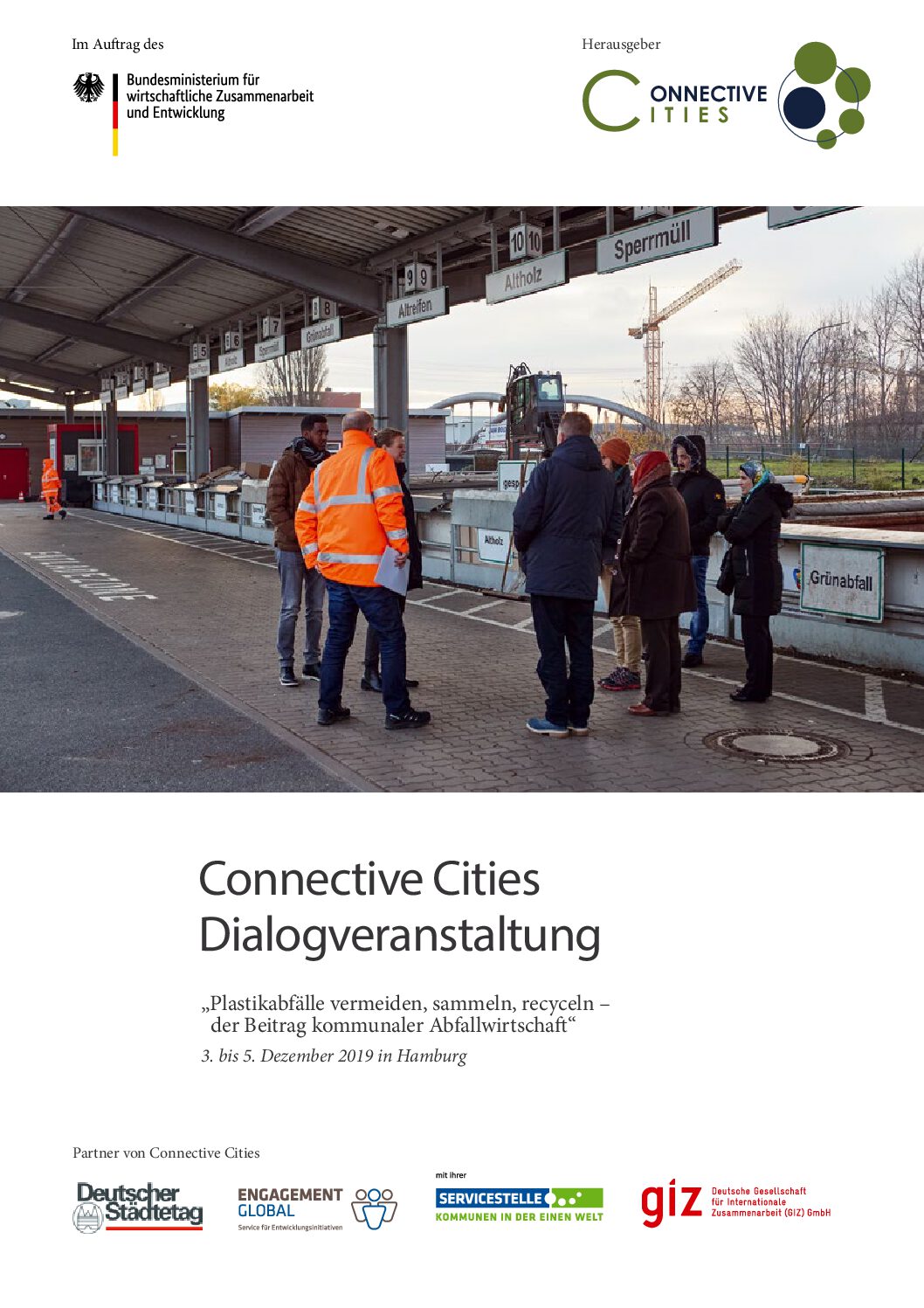
Knapp 40 kommunale Praktikerinnen und Praktiker aus 13 Städten, neun Ländern und vier Kontinenten tauschten in Hamburg intensiv ihre Erfahrungen zum Thema Plastikabfälle aus und entwickelten gemeinsam Lösungsansätze und Projektideen. Sie waren der Einladung von Connective Cities und der Stadtreinigung Hamburg zur Dialogveranstaltung „Plastikabfälle vermeiden, sammeln, recyceln – der Beitrag kommunaler Abfallwirtschaft“ gefolgt, die vom 3. bis 5. Dezember 2019 in der Hansestadt stattfand.

Am Ende der Tagung wurden acht konkrete Projektideen entwickelt, die ein ernsthaftes Potenzial haben, in der Praxis umgesetzt zu werden. Das Spektrum reichte vom Aufbau einer Dachorganisation für Müllsammlerinnen  und –sammler in Mitrovica, dem Aufbau eines Recyclingcenters in Himara, die ökonomisch nachhaltige Organisation der Sammlung wiederverwertbarer Abfälle in Vushtrri, die Automatisierung der Recyclinganlage in Kandy, die Entwicklung einer Kommunikationsstrategie für das Recyclingprojekt in Quito, die Etablierung von Mülltrennung auf Haushaltsebene in Hawassa, die Zertifizierung nachhaltiger Geschäfte in La Unión; bis hin zu einer Aktionsplanung für mehr Qualität und Wettbewerb bei der Müllsammlung in Mogadischu.

Die Dokumentation beschreibt ausführlich das Format der Dialogveranstaltung, die guten Praktiken und Ergebnisse der Arbeitsgruppen sowie die geplanten weiteren Schritte zur Umsetzung der entwickleten Projketideen.

Climate Resilient Urban Development in Southeast Europe

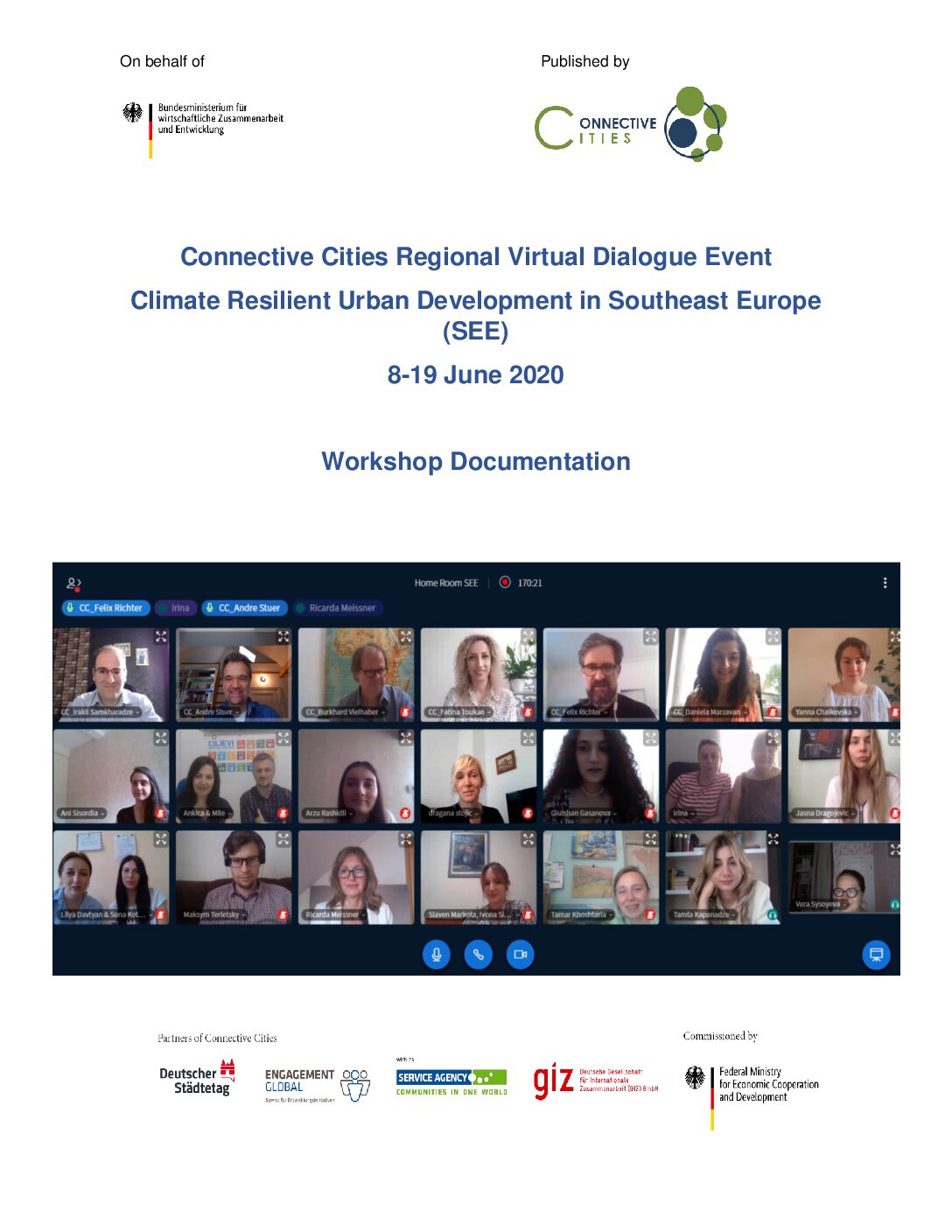
The virtual event was the first component of the learning process conducted by Connective Cities in Southeast Europe. The aim of the virtual event was to support knowledge exchange and networking by increasing the visibility of good practices from municipalities in SEE region on one hand, and on the other hand by facilitating the needed virtual space and tools to create innovative solutions for local challenges through knowledge exchange and peer-to-peer consultations.

The virtual event, thus, supported transforming dialogue and exchange possibilities into a digital and remote format especially during and in the aftermath of the COVID-19 outbreak affecting heavily the lifestyle of urban dwellers and planers. As this will include effects on sustainable urban development, municipal urban practitioners need to develop more innovative and agile processes to improve future crises responses. Here, the interest was mainly in pragmatic solutions and approaches that can be applied or adapted to the different regional/local contexts. Furthermore, the event offered a virtual platform to discuss the challenges around the theme of climate resilient urban development and supported municipalities in developing new project ideas among peers that can be further implemented in the respective home communities or in the framework of existing or new thematic municipal partnerships.

COVID-19 in African cities

„COVID-19, a global pandemic declared by the World Health Organization (WHO), is crippling the global economy and upending people’s lives thereby threatening sustainable development across all its dimensions. Africa is also facing the dire consequences of the crisis, necessitating timely response, recovery and rebuilding policies and strategies. Globally, urban areas are the epicenters of the epidemic accounting for most of the confirmed COVID-19 cases. UN-Habitat in collaboration with UN Economic Commission for Africa (UNECA), UN Capital Development Fund (UNCDF), United Cities and Local Governments of Africa (UCLG), African Development Bank (AfDB), and Shelter Afrique have joined hands to produce this new report: COVID-19 in African Cities: Impacts, Responses and Policies. The report proposes several interventions to promptly and effectively address the challenges of COVID-19 pandemic in Africa at the urban level led by national and local governments supported by international and regional development institutions.“

Decalogue for the post COVID-19 era

The COVID-19 pandemic is working as magnifying glass that highlights the aspects in which we were already behind, at a global scale. In a context of unprecedented and universal challenges local and regional governments around the world are at the forefront of the efforts to overcome these proving times as allies of other spheres of government, of the scientific community, and as global actors with important transformational and convening power. The Decalogue for the COVID-19 era is a political charter for the aftermath. It is the document that will guide international advocacy, and shape our thinking for the future of humanity, focusing on the commitment of local and regional governments to build a world of solidarity.

Klimaanpassung und Stadtentwicklung

Kommunen rund um den Globus bekommen die Auswirkungen des Klimawandels deutlich zu spüren. Dabei sind Städte als Wirtschafts- und Mobilitätszentren auf der einen Seite große Mitverursacher von klimaschädlichen Treibhausgasen, gleichzeitig werden die wichtigsten Maßnahmen zum Klimaschutz und zur Klimafolgenanpassung auf kommunaler Ebene entwickelt und umgesetzt. Da extreme Wetterereignisse wie Starkregen und Perioden extremer Trockenheit immer häufiger werden, sind Stadtentwicklungsprozesse ohne Berücksichtigung von Klimamaßnahmen nicht mehr denkbar. Kommunen weltweit können hier voneinander lernen und sich gegenseitig unterstützen. Das in Kooperation mit der Servicestelle Kommunen in der Einen Welt (SKEW) von Engagement Global entstandene aktuelle Welt-Sichten-Dossier widmet sich den Themen Klimaanpassung und Stadtentwicklung mit Beiträgen aus Deutschland, Lateinamerika und Südafrika. Best Practices unter anderem aus unserem Netzwerk Connective Cities zeigen, mit welchen Strategien sich Kommunen gemeinsam für resiliente und lebenswerte Städte engagieren.

Prevention of plastic waste in production and consumption by multi-actor partnerships

This study outlines the objectives, structure and work programme of the PREVENT Waste Alliance and provides a background to the prevention of plastic waste by describing the need for action, environmental impacts and risks to human health. To pool the know-how and practical experience of the various stakeholders in the PREVENT Waste Alliance re-garding plastic waste prevention, the study presents examples of smart practices along the plastic value chain implemented by members of the working group “Conserving re-sources” and their partners. The focus is on multi-actor partnerships and examples that can be transferred to other countries. The examples cover education & consulting, the establishment of reusable options, the development of waste prevention infrastructure, innovative products, studies on plastic waste prevention as well as guidelines & over-views of best practice examples.
Finally, the study offers recommendations for the further work of the PREVENT Waste Al-liance. This includes success factors for plastic waste prevention, necessary next steps and conclusions regarding required policy frameworks.

Cities SHIFT: Capacity building and networking for climate- and people-friendly mobility report

„With the pressing issues of congestion, air pollution, inequality, and climate change, the question is no longer if a sustainable and ecomobile transportation system will exist but when. Effective implementation can be realized by making an informed decision. This is imperative because you cannot manage what you do not know. This report demonstrates how the EcoMobility SHIFT+ tool can be adopted to assess and measure the transportation system of six cities in China, India, and Uganda. The EcoMobility SHIFT+ is a useful tool for local authorities to measure, assess, and act to improve ecomobility. Furthermore, evaluation and monitoring is an essential step in the process of developing sustainable urban mobility plans.“