


In 2017, the County Government of Nairobi declared Mukuru to be a Special Planning Area (SPA), paving the way for the preparation of an integrated Local Physical Development Plan (LPDP) for this large informal settlement in collaboration with its residents and partner organizations.
The SPA covers Mukuru Kwa Njenga, Mukuru Kwa Reuben and Viwandani which together accommodate around 300,000 low-income residents, many of them living in extreme income poverty.
Implementing this ambitious integrated plan will require finance for a wide range of infrastructure services and affordable housing as well as complementary financial interventions to support micro- and small enterprises.
This publication sets out a financing mechanism for the envisaged upgrading investments in informal settlements in Nairobi, pejoratively called “slums”. Mobilizing the vast amounts of capital required will face critical challenges, with affordability and land tenure at the forefront.
An important aspect of this report is how the upgrading of Mukuru and other informal settlements in Nairobi could be linked to these institutional innovations which seek to deliver infrastructure services and affordable housing at scale.
International experience on slum upgrading finance is examined early in the report in order to draw out general trends that provide a useful backdrop for Nairobi. The cases of India, Morocco and Egypt are set out and a general approach to slum upgrading finance presented.
Autor: erik
Vernetzungstreffen für kommunale Fachleute
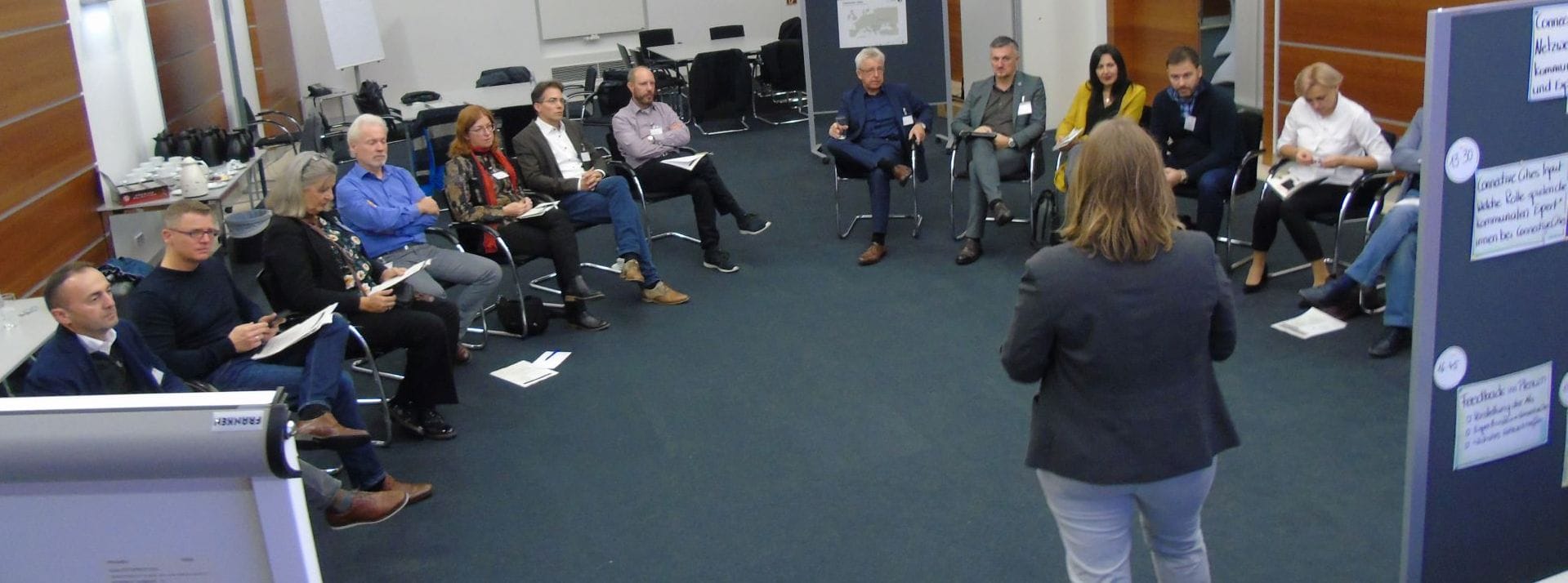
Am 7. und 8. Oktober 2019 veranstaltete die internationale Städteplattform Connective Cities ein Vernetzungstreffen für kommunale Fachleute ihres Expertenpools in der Hauptgeschäftsstelle des Deutschen Städtetages in Berlin. Ziel der Veranstaltung war es, mit den kommunalen Akteuren auf die vergangenen Aktivitäten der Städteplattform zurückzublicken und gerade neuen Expertinnen und Experten die Connective Cities-Methoden vorzustellen sowie ein Vernetzungsforum mit Akteuren zu bieten, die bereits Erfahrungen mit den Aktivitäten des Projekts gemacht haben.
The Future of Asian & Pacific Cities

A sustainable future occurs when planning lays a foundation; resilience guards against future risk; smart cities deploy the best technology for the job; and financing tools help pay for it all.
The report focuses on four essentials that cities must get right. Urban and territorial planning, strengthening resilience to future risks, supporting the effective interplay between people and technology, and financing tools, all of which are essential to deliver sustainable smart cities in our region. With three to five future policy pathways per chapter, the report offers ways to seize these opportunities and realize sustainable urban development by 2030. Regional cooperation and strong partnerships among all interested parties will be essential to pool expertise, accelerate progress and deliver the integrated approach needed.
Cities leading the way

Cities are already leading the way with ambitious plans to accelerate action on climate change. With more political will, community support and collaboration, cities can make an even greater contribution to securing a climate safe future.
The seven cities showcased here report that the planning process is an opportunity to engage internal and external stakeholders on the level of ambition needed and the roles different players can take. Co-creating the vision for the city and collaborating on the development of solutions ensures stakeholders have ownership of the process, support the long-term vision and take action themselves.
While each city has taken a different approach to the style and structure of their climate action plan/s, all of them demonstrate ambition and accelerated delivery as core objectives. The approaches highlighted in this report are intended to inspire other cities across the C40 Cities Climate Leadership Group and beyond to follow suit and play their part in delivering the objectives of the Paris Agreement.
Rather than attempt to summarise each city’s plan, the case studies presented in this report highlight a particular aspect that could be of interest to other cities.
Localising the 2030 Agenda through Integrated Urban Development
Action-oriented studies show that the 2030 Agenda will only be successful if implemented at the urban level and together with urban actors. In fact, cities – as actors and places – are crucial to achieve two thirds of all SDG targets. This insight and the principle of interconnectedness underpin the urgency to follow integrated approaches for sustainable urban development to break down barriers between sectors and stakeholders, and between institutions and levels of government. […] The publication describes five development projects implemented by the Deutsche Gesellschaft für Internationale Zusammenarbeit (GIZ) GmbH on behalf of the German Ministry for Economic Development and Cooperation (BMZ). These projects applied an integrated urban development approach that led to comprehensive and sustainable results in urban areas thereby contributing to the implementation of the 2030 Agenda.
Unlocking the Potential for Transformative Climate Adaptation in Cities

"Cities are increasingly integrating climate adaptation priorities into development policies and plans. However, there remains a gap in understanding how incremental urban adaptation solutions can lead to more transformative change over the long term. Transformative adaptation reorients urban climate actions around addressing entrenched equity and climate justice challenges. It focuses on systemic changes to development processes that improve people’s quality of life, enhance the social and economic vibrancy of cities, and ensure sustainable, resilient, and inclusive urban futures. This paper systematically reviews literature and case studies across the global North and South to assess the barriers and enablers to transformative climate adaptation, focusing on examples and evidence from a wide range of cities."
Urban-Rural Linkages: Guiding Principles

"The reciprocal and repetitive flow of people, goods and financial and environmental services (defining urban-rural linkages) between specific rural, peri-urban and urban locations are interdependent; they are the reality of socio-spatial arrangements, creating places with distinct yet interwoven, socially constructed identities. The benefits of investing in connective infrastructure and services, while building capacity for inclusive and functional territories linking urban and rural communities, are immense in all three areas of sustainable development: economic, social and environmental. The goal of these Guiding Principles is to inform pragmatic strategies and propose a Framework for Action to build an enabling environment for more inclusive and functional urban-rural linkages. The Guiding Principles also provide a reference for revising national and subnational rural, urban and territorial policy frameworks."
Integration of shared mobility approaches in Sustainable Urban Mobility Planning

This document provides guidance on a specific topic related to Sustainable Urban Mobility Planning (SUMP). It is based on the concept of SUMP, as outlined by the European Commission’s Urban Mobility Package1 and described in detail in the European SUMP Guidelines (second edition).
Numerous sharing concepts have emerged in recent years, which have been developing dynamically ever since. Some sharing concepts – esp. station-based car sharing – address alternatives to car ownership in order to reduce the space consumption, but others serve rather as an additional mobility option to get around: free floating car sharing and public bike rental systems, newer phenomena in the form of e-Scooter sharing and e-Moped sharing, on-demand mobility concepts (ride hailing and ride sharing) as well as the shared transport of goods (freight transport). The following brochure concentrates in particular on sharing services and the starting points for municipalities within a SUMP. It shows the steps in sustainable urban mobility planning when particular planning aspects must be taken into account while integrating sharing modes.
Women in Politics

In short, this study provides a global overview of the situation concerning the participation and representation of women in politics in Europe from the firm standpoint that gender equality in decision-making is a right, but also a highly political issue, essential to the positive advancement of our democracies. Good governance can only arise from just and healthy decisions taken by women and men together for the good of society as a whole.
While some progress has been made over the last ten years, women are still under-represented and the situation in local and regional government is of particular concern. In Europe today, only 15.4% of mayors are women.
The average proportion of women in local councils remains stuck below 30% (28.9%) and is only slightly higher in regional assemblies (30.9%). At this rate, how many years will it take before a 50–50 gender balance is reached among women and men in politics?
The Future is Now: Science for Achieving Sustainable Development,

In 2016, Member States decided that the report should be produced once every four years, to inform the quadrennial SDG review deliberations at the General Assembly, and that it should be written by an Independent Group of Scientists appointed by the Secretary-General. They mandated that the Group would consist of 15 experts representing a variety of backgrounds, scientific disciplines and institutions, ensuring geographical and gender balance.
The Future is Now: Science for Achieving Sustainable Development, is the first Global Sustainable Development Report prepared by the Independent Group of Scientists appointed by the United Nations Secretary-General. It does not produce new evidence; rather it capitalizes on existing knowledge across disciplines, through an “assessment of assessments”. It highlights state-of-the-art knowledge for transformations towards sustainable development and identifies concrete areas where rapid, transformational change is possible. The Report is not only a product but also a process for advancing collaboration among actors in science, Government, the private sector and civil society in all regions of the world towards identifying and realizing concrete pathways for transformation driven by evidence.