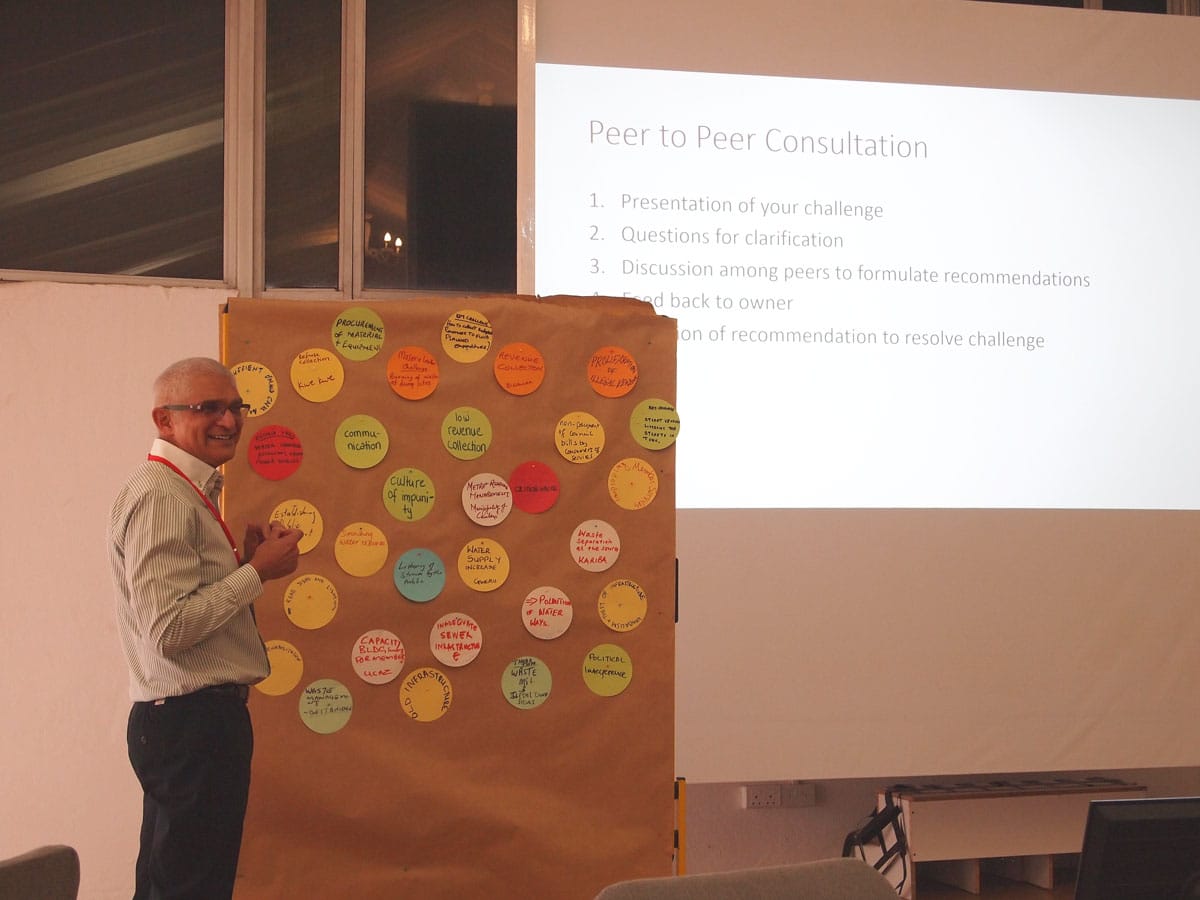
Verbesserung kommunaler Dienstleistungen auf lokaler Ebene

Connective Cities versammelte kommunale Praktiker aus Subsahara-Afrika und Deutschland zu der Dialogveranstaltung „Improving public service delivery at local level – solutions for participatory and accountable management“ vom 20. bis 22. August 2019 in Harare, Simbabwe.

Vor allem in Subsahara-Afrika stellen die dynamische Urbanisierung und der bedeutende ökologische und demografische Wandel neue Herausforderungen an die Grundversorgung. Daher lag der Schwerpunkt auf der Entwicklung von Ansätzen zur Verbesserung der Erbringung öffentlicher Dienstleistungen durch Beteiligung der Öffentlichkeit, um die soziale Verantwortung in den Bereichen Wasser, Abwasser, Abfallentsorgung und Verkehr zu erreichen.

21 Vertreter aus simbabwischen Gemeinden sowie eine Reihe von kommunalen Praktikern aus Südafrika, Lesotho, Sambia, Kenia und kommunalen Experten aus Deutschland tauschten ihre Erfahrungen anhand von Beispielen für bewährte Praktiken bei der Erbringung öffentlicher Dienstleistungen aus und definierten Lösungsansätze zur Verbesserung des Managements öffentlicher Dienstleistungen.

Die Dialogveranstaltung wurde in Zusammenarbeit mit dem GIZ-Projekt in Simbabwe „Stärkung des simbabwischen Städtetags UCAZ zur Förderung von interkommunalem Wissenstransfer und Capacity Development “ organisiert.

Adapt Now: A Global Call for Leadership on Climate Resilience

The report puts forward a bold vision for how to transform key economics systems, making them more resilient and productive. The Commission finds that climate adaptation can produce significant economic returns: the overall rate of return on investments in improved resilience is high, with benefit-cost ratios ranging from 2:1 to 10:1, and in some cases even higher.
The analysis specifically finds that investing $1.8 trillion globally in five areas from 2020 to 2030 could generate $7.1 trillion in total net benefits. The five areas of climate adaptation the report considers are: early warning systems, climate-resilient infrastructure, improved dryland agriculture, mangrove protection, and investments in making water resources more resilient. These represent just a portion of the total investments needed and total benefits available.
Recent events have shown that climate change affects people everywhere. Furthermore, without action, millions of people will be pushed further into poverty, leading to increased conflict and instability.

Klimawandelangepasste Stadtentwicklung

Knapp 30 kommunale Praktikerinnnen und Praktiker aus 12 Städten, 10 Ländern und vier Kontinenten folgten der Einladung von Connective Cities und von der Stadt Dortmund zur Dialogveranstaltung zum Thema „Klimawandelangepasste Stadtentwicklung“, die vom 3. bis 5. September 2019 in Dortmund stattfand.

Extreme Wetterereignisse als Folgen des Klimawandels wie Starkregen, schwere Gewitter, Stürme, anhaltende Dürren und Hitzewellen stellen Städte auf der ganzen Welt vor große Herausforderungen. Während der Klimawandel eine globale Herausforderung ist, ist die Anpassung an seine Auswirkungen hauptsächlich lokal. Darüber hinaus ist der Klimawandel ein Querschnittsthema, das alle Bereiche und Abteilungen einer Stadtverwaltung beeinflusst und daher einen bereichsübergreifenden Ansatz erfordert.

Beginnend mit einem Erfahrungsaustausch zu Guten Praktiken und Projekten in den Städten, wurden Herausforderungen bei der Umsetzung identifiziert und letztendlich sechs Projektideen für sechs Städte entwickelt, die zu einer Verbesserung der jeweiligen Strategien und Umsetzungspläne führen können.

Den Abschluss der Veranstaltung bildete eine Exkursion zum Phönixsee – ein Mega-Projekt der Stadt Dortmund zur Umwandlung einer Industriebrache in einen Wohn-, Arbeits- und Erholungsgebiet mit einem künstlichen See.

Urban Migration: Strengthening Cooperation with Civil Society

"While migration is often seen as a national issue, and most of the mandate around immigration, refugees and asylum falls to the central government, it is often cities and local governments that have to directly deal and address the needs of newly arrived migrants, and the inclusion of long-term migrant residents. […] At the same time, civil society organizations (CSOs) have taken an increasingly important role in supporting migrants by undertaking initiatives that raise awareness, facilitate access to basic services, advocate for their rights and strengthen social inclusion. The role of CSOs as key partners for local authorities in the governance of migration and other urban governance issues is widely recognized, but it is not always clear how to articulate these partnerships and coordinate efforts while securing the autonomy of these organizations and avoiding potential tensions or conflicts of interest."
In June 2019, UCLG ́s Learning team coordinated a workshop and peer learning event focusing on “Building trust through strengthened cooperation: the role of civil society in the urban governance of migration” in Sfax, Tunisia. The workshop was part of the Mediterranean City to City Migration (MC2CM) project. In the process of the event some key learnings and recommendations have been worked out. The documentation includes case studies from Sfax, Tunisia; Malaga, Spain;  Brital, Lebanon; Douala, Cameroon and Meknes, Morocco. 

Digitalisation in the Lives of Urban Migrants

As increased migration, particularly to urban centres, and digitalisation play a greater role in development cooperation, more research on how these phenomena interact will become critical. Information communication technologies (ICTs) offer pathways for potentially making it easier for migrants to settle in, whether it be through e-government programmes or by accessing social networks that can help in finding housing and work. To better understand how ICTs fit into urban migrants’ lives, researchers from the German Development Institute have used new survey data in Bogota comparing how long-term residents, short-term residents, and Venezuelan migrants access and use ICTs.

Integrated Implementation of the 2030 Agenda in Cities and City-Regions

GIZ and the authors in this publication series observe increasing spatial and functional interrelations between cities, settlements and their surrounding rural areas and argue that the city-regional scale is highly relevant and call for paradigm shifts towards urban and regional planning, financing and implementation across sectors, stakeholders, administrative borders and governmental level. The studies and discussion papers in this publication series cover a diverse set of cityregional challenges and solutions gathered around the focus areas “Integrated Implementation of Global Agendas”, “Metropolitan Governance”, “Integrated Territorial Development for Strengthening Urban-Rural Linkages – including City Region Food Systems”, “Urban Resource Management and Climate Change”, “Digitalisation and Urban Development – Smart Cities” and “Regional Economic Development and Innovative Business Regions”. The studies and discussion papers aim at promoting the local implementation of Sustainable Development Goals (SDGs), the Paris Climate Agreement and the New Urban Agenda (NUA) which acknowledge the mutual dependencies between cities and regions as key potentials for inclusive and sustainable development.

The GIZ publication provides an overview of studies, discussion papers and digital sources related to urban and metropolitan issues from the perspective of German development cooperation.

Towards the Localization of the SDGs

"This Report explores the involvement of Local and Regional Governments (LRGs) in the localization of the Sustainable Development Goals (SDGs). Following UN guidelines, it complements the Voluntary National Reviews (VNRs) submitted by 143 countries to the High-Level Political Forum (HLPF) throughout the first four- year cycle of voluntary reporting. It delivers first-hand information from LRGs in 80 different countries, including 24 of the 47 countries reporting in 2019."

Klimaschutz und Luftreinhaltung

"Im Klimaschutz und in der Luftreinhaltung verbergen sich viele Synergieeffekte, die es in den Kommunen zu identifizieren und zu nutzen gilt. Sei es in der Verkehrssteuerung, im eigenen Fuhrpark, in der Stadtentwicklung oder in der Grün- und Freiraumplanung, beim Ausbau von Fuß- und Radwegen sowie in der Förderung des ÖPNV: Viele Maßnahmen in der Luftreinhaltung dienen auch dem Klimaschutz und umgekehrt. Hier lohnt es sich, genauer hinzuschauen und den Doppelnutzen für Umwelt und Gesundheit auszuschöpfen.
Die Publikation zeigt in fünf Beiträgen und vier Exkursen Beispiele unterschiedlicher Strategien und Maßnahmen für saubere Luft in Kommunen auf und gibt Impulse, wie die beiden Themenfelder miteinander verknüpft werden können."

Resilient Cities, Resilient Lives

„The world is more densely populated and more interconnected than ever before. From extreme weather to refugee crises, from disease pandemics to cyberattacks, today’s state of play requires new models of governance to mitigate risk and respond to challenges. Business-as-usual models of reactive planning and siloed decision-making will not generate the fundamental strength and flexibility essential for us to thrive in the face of the shocks and stresses of the 21st century. […] The launch of 100 Resilient Cities program (100RC) by the Rockefeller Foundation acknowledged that the escalating trends of urbanization, globaliza- tion, and climate change pose tremendous risks, but also offer a tremendous opportunity. This report shares 100RC’s knowledge about what it takes to catalyze an urban resilience movement.“

Heatwave Guide for Cities

"Heatwaves are deadly and their impacts are on the rise globally due to climate change. People living in urban areas are amongst the hardest hit when a heatwave occurs because these are hotter than the surrounding countryside. Along with climate change, urbanization is one of the most transformative trends of this century and the last. Over half the world now lives in urban areas and this is projected to increase to two-thirds by 2050. It is crucial that cities incorporate heat-reduction tactics such as green spaces into their plans for growth or retrofit them in built areas. […] This practical guide is designed with, and for, people working in city government to understand, reduce the risk of, and respond to, heatwaves in their cities."