


„Since 2006 the Global Gender Gap Index has been measuring the extent of gender-based gaps among four key dimensions: Economic Participation and Opportunity, Educational Attainment, Health and Survival, and Political Empowerment. The index is tracking progress towards closing these gaps over time. The 2020 edition of the report benchmarks 153 countries and provides country rankings that allow for effective comparisons across and within regional peers. The report highlights the growing urgency for action. Without the equal inclusion of half of the world’s tal- ent, we will not be able to deliver on the promise of the Fourth Industrial Revolution for all of society, grow our economies for greater shared prosperity or achieve the UN Sustainable Development Goals. At the present rate of change, it will take nearly a century to achieve parity, a timeline we simply cannot accept in today’s globalized world, especially among younger generations who hold increasingly progressive views of gender equality.“
Autor: erik
Grüne städtische Infrastruktur für asiatische Städte
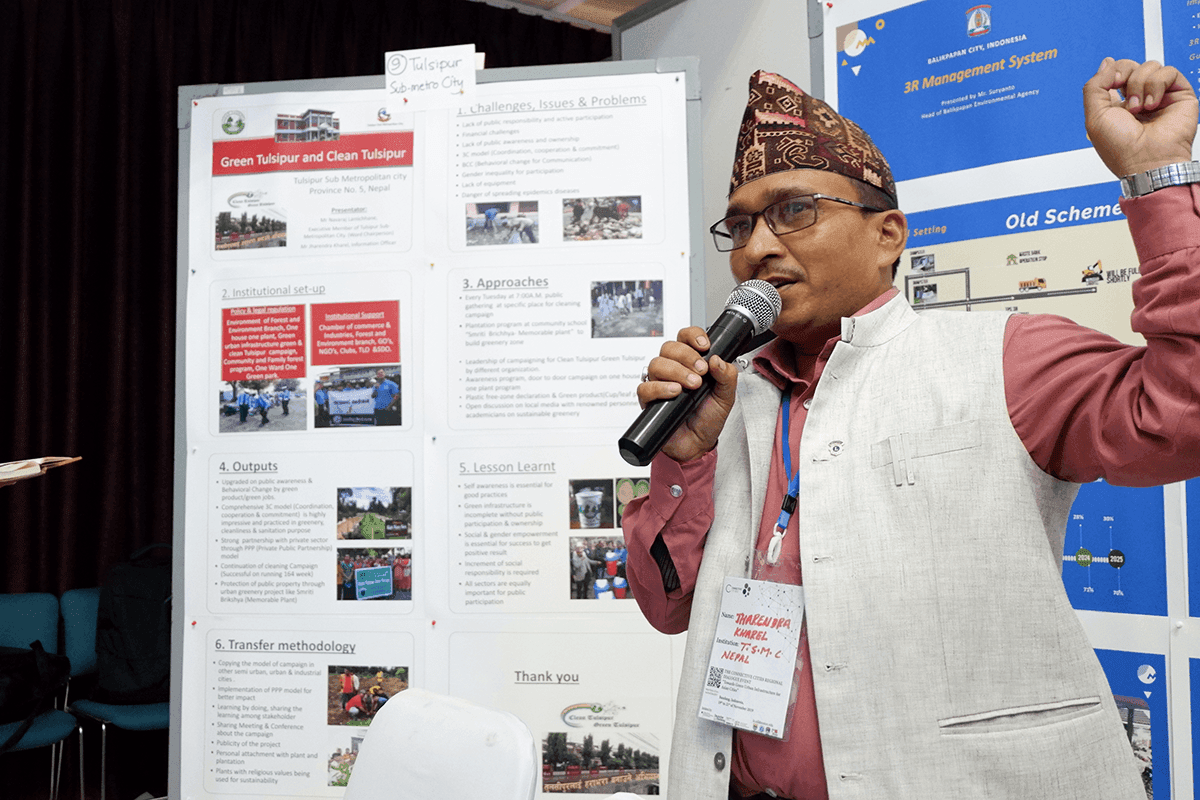
Vom 19. bis 21. November 2019 fand in Bandung / Indonesien die regionale Dialogveranstaltung „Grüne städtische Infrastruktur für asiatische Städte“ von Connective Cities statt. Teilgenommen haben über 25 Fachleute aus Indonesien, Malaysia, Nepal und Deutschland, die sich über ihre Erfahrungen und guten Praktiken ausgetauscht haben.
Da in Asien die weltweilt schnellste Urbanisierung nachgewiesen wird und diese rapide Entwicklung in den meisten Regionen und Städten unaufhaltbar ist, sollte sie gezielt optimiert und angepasst werden. Aus den ständig wachsenden urbanen Strukturen können und sollen alle möglichen Vorteile sinnvoll genutzt werden, gleichermaßen sollten negative sozioökonomische und ökologische Auswirkungen soweit verringert oder vermieden werden.
In den meisten asiatischen Städte steigt stets die Notwendigkeit, umweltbewusste Entwicklungskonzepte für städtische Infrastrukturen durch sinnvolle Planung und Verwaltung zu erstellen. Die Entwicklung „grüner“ Städte ist für eine nachhaltige Urbanisierung von entscheidender Bedeutung. Dazu gehört die Entstehung von städtischen Infrastrukturen mit den dazugehörigen öffentlichen Dienstleistungen für alle Einwohner, darüber hinaus soll eine Balance zwischen den positiven und negativen Auswirkungen der schnellen Urbanisierung gefunden werden.
Um die vorhandenen oder zukünftigen Infrastrukturen nachhaltiger zu gestalten, können viele Bereiche berücksichtigt und bearbeitet werden. Relevant sind Themen wie: Wasserversorgung, umweltfreundliche und Ressourcen-schonende Bauweisen, öffentliche sanitäre Anlagen, Nutzung von erneuerbaren Energien, Abfallwirtschaft, öffentlicher Raum usw. Viele Städte haben bereits einige Ansätze der grünen städtischen Infrastruktur eingeführt und zum Teil auch etabliert, dennoch bleiben Herausforderungen wie hohe Kosten vieler Lösungen und die gleichberechtigte Zugänglichkeit bestehen.
Plastikabfälle – Der Beitrag kommunaler Abfallwirtschaft zur Lösung des Problems

Knapp 40 kommunale Praktikerinnnen und Praktiker aus 13 Städten, 9 Ländern und vier Kontinenten tauschten intensiv ihre Erfahrungen zum Thema „Kunstoffabfälle“ aus und entwickelten gemeinsam Lösungsansätze und Projektideen. Sie waren der Einladung von Connective Cities und der Stadt Hamburg zur Dialogveranstaltung zum Thema „Plastikabfälle – Der Beitrag kommunaler Abfallwirtschaft zur Lösung des Problems“ gefolgt, die vom 3. bis 5. Dezember 2019 in Hamburg stattfand.
Wachsende Mengen an Kunststoffabfällen stellen Kommunen weltweit vor Herausforderungen. Nur geringe Mengen lassen sich sortenrein recyceln und so geschlossene Kreisläufe herstellen. Aber auch ein Recyceln in minderwertigere Plastiksorten kann Mülldeponien entlasten und Einkommen für vulnerable Gruppen schaffen. Die Vermeidung von Kunststoffabfällen ist jedoch die beste Option. Kunststoffabfälle sind daher in erster Linie eine soziale Herausforderung: Die Änderung des Verhaltens von Verbrauchern und Produzenten ist entscheidend.
Beginnend mit einem Erfahrungsaustausch zu Guten Praktiken und Projekten in den Städten, wurden Herausforderungen bei der Umsetzung identifiziert und letztendlich acht Projektideen für acht Städte entwickelt, die zu einer Verbesserung der jeweiligen Strategien und Umsetzungspläne führen können.
Den Abschluss der Veranstaltung bildeten drei parallele Exkursionen zu einer Müllverbrennungsanlage, einer Sortierstation und einer Abfallsammelstelle in Hamburg.
Global Roadmap of Action

The report draws attention to the trend of isolated technologies – such as electric vehicles, for example – being over-promoted. The obvious idea is to cut greenhouse-gas emissions, but that will only happen if the electric power used is generated by renewable means, which often is not the case. Moreover, the authors warn that it is not healthy to reduce the diversity in the means of transport. While appreciating the progress made in some areas, the SuM4All report insists that the need for a fundamental, systemic transformation is not being met.
The report proposes a list of the most relevant policies for making transport systems sustainable. It offers no blueprint, because each country must take action according to its specific situation. However, SuM4All presents various instruments in four toolboxes:
- Regulatory and institutional instruments include rules on safety, vehicle use, emissions, transport services, cross-border traffic and data management.
- The technology toolbox covers the planning, provision and maintenance of transport infrastructure and services. In this context, the coordination of different means of transport is particularly important and deserves attention at every stage. Safety regulations must be observed as well.
- The economic and financial toolbox includes concerning taxation, subsidies, loans, pricing et cetera. Close coordination of the public sector, which bears responsibility for infrastructure, with profit-driven companies is essential. Private individuals and companies use the system, and the latter provide innovative technologies, products, services and business models.
- The communication toolbox helps to run awareness raising geared to changing behaviour, identifying transport alternatives and managing knowledge.
Klimagerechte und klimaresiliente Stadtentwicklung

Als Auftakt des neuen Lernprozesses von Connective Cities in Lateinamerika fand vom 26.-28. November 2019 in Niterói, Brasilien die Dialogveranstaltung „Klimagerechte und klimaresiliente Stadtentwicklung“ statt. Kooperationspartner der Veranstaltung waren die Stadt Niterói und UCLG Learning.
Die 32 Teilnehmenden der Veranstaltung, in erster Linie kommunale PraktikerInnen, kamen aus 17 Städten in sechs Ländern: Brasilien, Deutschland, Ecuador, Kolumbien, Argentinien und Mexiko. Alle der Teilnehmenden arbeiten in ihren Städten bzw. Projekten zu der Thematik Klimaresilienz/Klimaanpassung im Kontext nachhaltiger Stadtentwicklung. Ziel der Veranstaltung war ein Erfahrungs- und Wissensaustausch unter kommunalen Praktikern über das Thema, des Kennenlernen guter Praktiken und die gegenseitige kollegiale Beratung sowie die Entwicklung von Projektideen für die weitere Bearbeitung in den Folgeveranstaltungen.
Im Rahmen einer Exkursion konnte die Gruppe zunächst einige der aktuell laufenden und bereits abgeschlossenen Projekte der Stadtverwaltung Niterói in situ kennen lernen, und danach bei einem Treffen mit dem Bürgermeister Rodrigo Neves weitere Einblicke gewinnen.
15 Pathways to localise the Sustainable Development Goals

This publication illustrates how the 15 pathways of the Basque Declaration can be used by towns and cities to localise the Sustainable Development Goals (SDGs).
In this publication, the 15 pathways of the Basque Declaration are illustrated with stories taken from the Transformative Action database of the Sustainable Cities Platform. Each of these stories are former applications to the Transformative Action Award 2017-2019 and have been reviewed by a jury of experts, which includes representatives from the European Committee of the Regions, the European Investment Bank, UNESCO Etxea, the City of Aalborg (Denmark) and ICLEI Europe.
The purpose of these stories is to provide local governments and other local stakeholders with inspiration for action, rather than the formulation of yet another action plan. The examples also give insight into how to implement the goals using an integrated approach across sectors and departments. For each story, the most relevant pathway and SDGs are indicated, based on an independent assessment by ICLEI Europe. They show the diversity of approaches across topics, geographical locations and local cultures.
The Power of Cities

„The World Health Organization (WHO) has identified urbanization as one of the key challenges for public health in the 21st century. It is typically discussed in negative terms, including infectious outbreaks, unhealthy lifestyles and environmental threats. Yet cities offer significant opportunities to improve public health through health-enhancing policies and actions. […] City leaders are key allies in delivering national public health objectives among large parts of the population. City leaders have the means, opportunity and obligation to protect the health and well-being of their people by defining priorities, uniting stakeholders around common goals, and ensuring accountability for outcomes. City leaders’ commitment is important not just for the health of cities, but for global health as a whole. […] Cities are the main implementation sites for national health policies and programmes – without their support, global targets are unlikely to be achieved. This report is a call for city leaders to rise to the challenge and show the world how local action can help solve global health problems.“
Resilient cities, thriving cities: The evolution of urban resilience

„This report uses the decade-long experience of the Resilient Cities Congress series as a proxy to track the evolution of the global resilience debate over the last ten years, creating a solid base to build the next decade of bold action.
It explores a variety of resilience approaches; for example, how multi-stakeholder planning has contributed to finance and boosted local resilience, or how leveraging nature-based solutions has enabled cities’ adaptation to climate change and improved people’s quality of life. The report also provides successful examples of social cohesion benefitting physical resilience, especially in informal settlements.“
Understanding Infrastructure Interdependencies in Cities

„Modern urban infrastructure and their systems of operation are highly interdependent. They are formed of multiple connections, feedback and feedforward paths, and intricate branching where services or information are transferred across city sectors. This means that if one system fails, it can have cascading impacts on other systems. Climate change can compound these impacts significantly. Some systems may be directly affected by climate change events – such as roads during flooding. Other systems may be affected indirectly, such as the health sector and the financial sector if there are power outages. The interdependencies of city systems combined with climate impacts can lead to a ripple effect of disruptions. Understanding infrastructure interdependencies and critical failure points is therefore vital to achieving long- term climate resilience across a whole city.“
Urban Girls Catalogue

The Urban Girls Catalogue is a guide in inclusive urban planning, a deep dive into the process behind#UrbanGirlsMovement and an encyclopedia of good examples that showcase how feminist and participatory urban planning can lead to improved living conditions for society at large.
These are the results from #UrbanGirlsMovement, where we have composed a catalogue featuring: Global good practices of feminist urban development (part II); the results from the pilot case #UrbanGirlsMovement Botkyrka (part III); lessons learned from the entire initiative (part IV), as well as guidelines and policy recommendations for implementing parties and local, regional, national and global policy-makers (part V). The aim of this catalogue is for you, the reader, to find the necessary arguments for challenging set norms in your specific urban development context.