Towards the Localization of the SDGs – 4th Report

LOCAL AND REGIONAL GOVERNMENTS’ REPORT TO THE 2020 HLPF 4th REPORT

The fourth report of the local and regional governments (LRGs) to the HLPF: Towards the Localization of the SDGs (2020) has been produced at a difficult time, when the world is suffering the effects of a global pandemic. The impact of this crisis on the social and economic fabric of our communities is, however, still difficult to measure. Within this context, the words “solidarity” and “cooperation” take on an even more relevant meaning. This was the message of the UN Secretary-General in his report to the HLPF and it reflects the feelings of our constituency, based on the experiences of numerous cities and territories.

The transformative framework of the universal development agendas remains essential for a more sustainable future. Local and regional governments from all over the world are reinstating their strong commitment to achieve the transformation that their societies call for after the pandemic through the potential of the SDGs and the universal development agendas.

In this context, the report analyses the evolution of the process of SDG localization in cities and territories throughout the world, particularly focusing on the 47 countries reporting this year. In doing this, it builds upon the information presented in the Voluntary National Reviews (VNRs) and on the views expressed by LRGs through their own reports (more than 40 Voluntary Local Reviews from cities and regions and six reports from LGAs which provide a wider, subnational view of the localization process in the countries reporting this year). It also collects together the answers to the GTF survey, with the visions of LRGs from 75 countries. This report will be presented during the Local and Regional Governments’ Day at the 2020 High-Level Political Forum.
Political Forum.

Cities Policy Responses

This note was developed by the OECD Centre for Entrepreneurship, SMEs, Regions and Cities (CFE) in collaboration with the OECD Working Party for Urban Policy and the OECD Champion Mayors Initiative for Inclusive Growth. It is an update of the earlier versions released on 27 March and 13 May, which expands the examples of measures taken by cities to respond to COVID-19 and recover from the economic and social crisis. The note provides analysis on issues related to the economic, social and environmental impacts, lessons learned in terms of digitalisation, mobility, density, urban design and collaborative governance, and action-oriented guidance to build back better cities, building on previous work on urban resilience. Short and medium term responses provided by cities are clustered around six categories: i) social distancing; ii) workplace and commuting; iii) vulnerable groups; iv) local service delivery; v) support to business; and vi) communication, awareness raising and digital tools. The note also includes updated information on how cities are progressively exiting the lockdown.

Teilnahmeaufruf: Verbesserung der städtischen Wasserversorgung, Abwasserentsorgung und städtischen Mobilität in Subsahara-Afrika

„Neudefinition der Dienstleistungserbringung in nie dagewesenen Zeiten“ – Intermittierende virtuelle Sitzungen zwischen dem 7. und 18. September 2020

Afrikanische Städte in Subsahara-Afrika stehen vor der großen, ihren Einwohnerinnen und Einwohnern ein Mindestmaß an Lebensqualität durch eine gut funktionierende Grundversorgung und Infrastruktur bereitzustellen. Diese ist auch von zentraler Bedeutung für die wirtschaftliche Leistungsfähigkeit der Städte. Zu den wichtigsten Dienstleistungen, die Städte anbieten, gehören Verkehrsnetze, Wasser- und Abwasseranschlüsse, Elektrizität, Gesundheit, Bildung und eine ganze Reihe anderer Hilfsdienste wie Straßenreinigung und die Instandhaltung öffentlicher Räume.

Connective Cities lädt kommunale Fachleute aus Subsahara-Afrika und Deutschland ein, an der virtuellen Dialogserie zum Thema „Verbesserung von Effizienz und Effektivität in den Bereichen Wasserversorgung, Abwassermanagement und städtische Mobilität“ teilzunehmen. Durch den interkommunalen Wissensaustausch  und gegenseitiges Lernen soll die Fähigkeit der Kommunen zur Bereitstellung nachhaltiger öffentlicher Dienstleistungen gestärkt werden.

Das Thema wird anhand von drei spezifischen Fragestellungen behandelt:

  1. Wasserversorgung: Ansätze und Technologien, die den Zugang zu sauberem Trinkwasser zu verbessern
  2. Abwassermanagement: Herausforderungen und Technologien für ein funktionierendes kommunales Abwassermanagement
  3. Städtische Mobilität: effektives und umweltgerechtes Verkehrsmanagement

Auch die Covid-19-Pandemie erfordert ein Überdenken, wie Städte ihre Projekte gestalten, um sich gegen die negativen Auswirkungen abzusichern und auch in Zukunft im Falle einer Pandemie widerstandsfähig zu bleiben.

Bei Fragen wenden Sie sich bitte an:

Connective Cities und die Pandemie

Liebe Expertinnen und Experten, liebe Kolleginnen und Kollegen,

aktuell stehen viele Kommunen weltweit vor vielen Herausforderungen, die zum Teil erst wegen der COVID-19 Pandemie entstanden sind, oder vor solchen, die dadurch noch komplexer und schwerwiegender geworden sind. In Anbetracht der vielerorts anhaltenden Reise- und Versammlungseinschränkungen werden wir bis auf weiteres unsere anstehenden Veranstaltungen in verschiedenen virtuellen Formaten anbieten, Präsenzveranstaltungen werden gegebenenfalls als Folgeveranstaltungen soweit möglich auf spätere Zeitpunkte verschoben.

Der fachliche Austausch wird sowohl mit regionalen und thematischen Schwerpunkten entsprechend der aktuellen Bedarfe weitergeführt. Die neuen Formate bieten neben der bewährten Connective Cities Methodologie einige verschiedene neue virtuelle Instrumente, die gemeinsame Ideenentwicklung und Erarbeitung passende Lösungen stärken können. Weitere Informationen über bevorstehenden Veranstaltungen werden über unsere üblichen Kommunikationswege angekündigt.

Ihr Connective Cities Team

Series of virtual events on local climate leadership in times of COVID-19

The GIZ project „Climate Policy Meets Urban Development“ is organizing a series of three online-seminars on local climate action in times of #COVID19. The series will kick off with its first online-seminar on 7 July 2020, 3-4 pm (CEST/UTC+2). The session will introduce Germany’s multi-level governance framework with a focus on the German National Climate Initiative (NCI) and its mechanisms to foster local climate projects.

Session 2 on maintstreaming climate projects into city governance frameworks and session 3 on steering local climate leadership trough collaborative action will take place on 1 September and 5 October. 

More Info

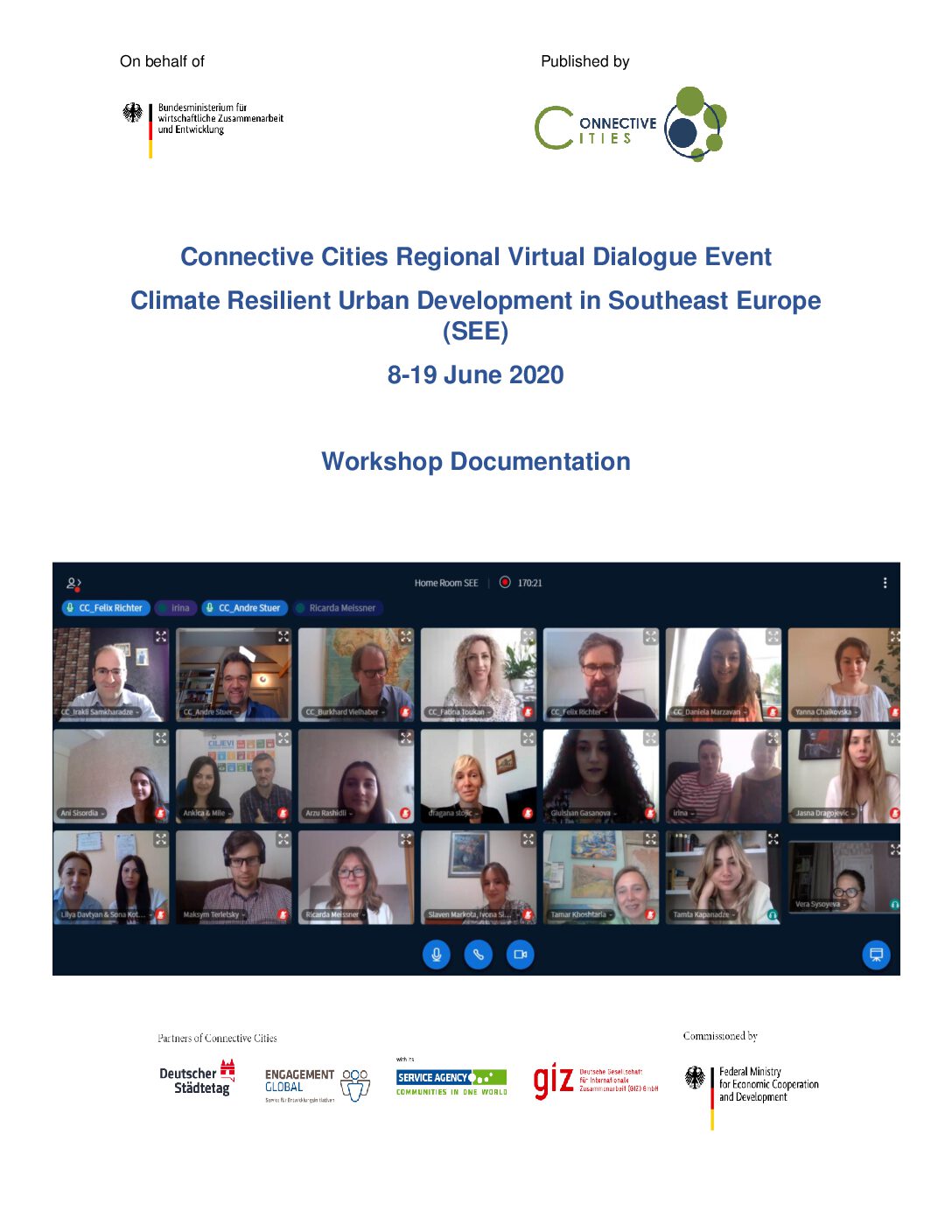
Climate Resilient Urban Development in Southeast Europe

The virtual event was the first component of the learning process conducted by Connective Cities in Southeast Europe. The aim of the virtual event was to support knowledge exchange and networking by increasing the visibility of good practices from municipalities in SEE region on one hand, and on the other hand by facilitating the needed virtual space and tools to create innovative solutions for local challenges through knowledge exchange and peer-to-peer consultations.

The virtual event, thus, supported transforming dialogue and exchange possibilities into a digital and remote format especially during and in the aftermath of the COVID-19 outbreak affecting heavily the lifestyle of urban dwellers and planers. As this will include effects on sustainable urban development, municipal urban practitioners need to develop more innovative and agile processes to improve future crises responses. Here, the interest was mainly in pragmatic solutions and approaches that can be applied or adapted to the different regional/local contexts. Furthermore, the event offered a virtual platform to discuss the challenges around the theme of climate resilient urban development and supported municipalities in developing new project ideas among peers that can be further implemented in the respective home communities or in the framework of existing or new thematic municipal partnerships.

COVID-19 in African cities

„COVID-19, a global pandemic declared by the World Health Organization (WHO), is crippling the global economy and upending people’s lives thereby threatening sustainable development across all its dimensions. Africa is also facing the dire consequences of the crisis, necessitating timely response, recovery and rebuilding policies and strategies. Globally, urban areas are the epicenters of the epidemic accounting for most of the confirmed COVID-19 cases. UN-Habitat in collaboration with UN Economic Commission for Africa (UNECA), UN Capital Development Fund (UNCDF), United Cities and Local Governments of Africa (UCLG), African Development Bank (AfDB), and Shelter Afrique have joined hands to produce this new report: COVID-19 in African Cities: Impacts, Responses and Policies. The report proposes several interventions to promptly and effectively address the challenges of COVID-19 pandemic in Africa at the urban level led by national and local governments supported by international and regional development institutions.“

Decalogue for the post COVID-19 era

The COVID-19 pandemic is working as magnifying glass that highlights the aspects in which we were already behind, at a global scale. In a context of unprecedented and universal challenges local and regional governments around the world are at the forefront of the efforts to overcome these proving times as allies of other spheres of government, of the scientific community, and as global actors with important transformational and convening power. The Decalogue for the COVID-19 era is a political charter for the aftermath. It is the document that will guide international advocacy, and shape our thinking for the future of humanity, focusing on the commitment of local and regional governments to build a world of solidarity.

Call for participants: Municipal Response to the COVID-19 Pandemic

A series of virtual events will be organised with the focus on municipal response to the pandemic. This municipal knowledge-exchange activity aims at analysing and discussing practical examples from municipalities in MENA, Sub Saharan Africa and Germany. The event will thus provide a platform for learning how to plan, manage and evaluate effective measures to curb the impacts of the pandemic. It will also be possible to discuss individual questions with urban practitioners. Municipal representatives from both political and technical levels are invited to participate in the exchange.

Thematic focus of the events

1. Public health and municipal administrative processes:

All countries evoked the public health legal framework and the WHO guidelines to enforce measures to reduce the spread of the virus. Nevertheless, the pandemic has revealed shortcomings in municipal capacities to overcome its implications. Investing in digitalizing municipal administrative processes, IT systems as well as the overall healthcare infrastructure is being prioritized by many localities. Countries have also applied a combination of measures and technologies to monitor and control the situation at both the local and national levels. This session will focus on the possible strategies and measures implemented by public health and administrative municipal actors.

2. Municipal service delivery including water, sanitation and solid waste management:

Maintaining high standards of hygiene requires adequate provision of urban services such as water, sanitation and solid waste management which are key in combatting the spread of the virus. In many regions, the pandemic has heightened the existing shortcomings in the provision of these services. Some municipalities have provided temporal measures in order to improve the service delivery. Urban informal settlements in particular, are struggling with the situation, especially where social distancing rules cannot be effectively enforced. This session will focus on municipal service providers in the water and sanitation sectors.

3. Economic impact:

The pandemic has negatively impacted the economy on all levels. Most countries resolved to partial or complete lock down that resulted in paralyzing many economic sectors. It is in those cities that imposed the strictest lock down measures that the negative economic impacts are most apparent as per initial observations. A significant part of the labour markets in developing countries is informal and is comprised of daily wagers who have suffered immensely from the lockdown measures that impacted their livelihoods and ability to pay for services. These measures have also had a negative impact on the revenue stream for the municipalities. On the flip side, some economic sectors are witnessing growth. For example, many cities are relying on local manufacturing enterprises to produce medical equipment like masks, protective gear and ventilators which they would import in the past. This session will focus on possible measures to cushion the negative economic impacts of the pandemic on the local level.

More information: Call for Participants

Contact

If you wish to participate kindly email Dr. Muna Shalan (muna.shalan@giz.de) for MENA region, Sophia Kamau (sophia.kamau@giz.de) for Sub Saharan Africa and Alex Wagner (Alexander.Wagner@engagement-global.de) or Thiago Garcia (Thiago.Garcia@engagement-global.de) for German cities and counterparts

Deutsch-Türkische Städtepartnerschaftskonferenz

Die deutschen Auslandsvertretungen in der Türkei planen in Kooperation mit dem Deutschen Städtetag (DST) und dem Verband Türkischer Kommunen (Türkiye Belediyeler Birliği, TBB) und mit Unterstützung der Stadt Istanbul (Istanbul Büyükşehir Belediyesi, IBB) eine zweitägige Deutsch-Türkische Städtepartnerschaftskonferenz in Istanbul im 2. Halbjahr 2020. Die Städtepartnerschaftskonferenz soll Städtekooperationen entlang gemeinsamer Interessen und Herausforderungen befördern sowie erfolgreiche Ansätze und zusätzliche Unterstützungsangebote für die konkrete Projektzusammenar-beit zwischen den Kommunen aufzeigen. Damit leistet sie einen Beitrag um die deutsch-türkischen Beziehungen nachhaltig zu vertiefen und zu verbreitern.

Als Auftakt der Deutsch-Türkischen Städtepartnerschaftskonferenz wird vom 15. bis 18. Juni 2020 eine virtuelle Vorkonferenz stattfinden. Diese besteht u.a. aus vier Fachworkshops zu folgenden Themen:  

  1. Digitale Stadt
  2. Nachhaltige Stadtentwicklung
  3. Schutzfunktion der Kommunen für marginalisierte Gruppen und Geflüchtete in der COVID-19-Krise
  4. Jugendaustausch in partizipativ orientierten Städtepartnerschaften

Die Fachworkshops richten sich vorrangig an kommunale Expertinnen und Experten und dienen dem Austausch von Herausforderungen und „best practices“ sowie der Vorstellung erfolgreicher Städte-kooperationen in den jeweiligen Themenbereichen. Die Inhalte und Zielsetzungen der einzelnen Fachworkshops werden auf den nachfolgenden Seiten beschrieben. Die Ergebnisse des Austauschs werden bei der Informationsveranstaltung am 18. Juni vor einem breiteren Publikum von bis zu 200 Personen vorgestellt und auch im darauffolgenden Oberbürgermeister/innen-Roundtable diskutiert.

Weitere Informationen zur Anmeldung, zum Programm und den technischen Voraussetzungen entnehmen Sie bitte der Konferenzankündigung.