Strengthening the local implementation of the Sustainable Development Goals (SDGs) through local reviews and monitoring

Connective Cities organised an international virtual dialogue event aimed to strengthen local implementation of the SDGs through local reviews and monitoring. The event was held in partnership with United Cities and Local Governments (UCLG) and PLATFORMA and co-hosted by the City of Bonn, which is a front runner in municipal SDG strategies and reporting and published its first Voluntary Local Review (VLR) in October 2020.
Almost 60 participants from 19 countries in Europe, Asia, Africa, North and Latin America were able to experience the benefits of working in a global learning community. Participants came from a broad variety of backgrounds, including municipalities, civil society, local government associations, international city networks, universities and United Nations agencies.
The dialogue event focused on three main thematic issues

  • data availability and data collection systems,
  • data-driven policy development and contribution to different levels of governance, and
  • quality citizen dialogue and stakeholder engagement.

During the sessions, participants had the opportunity to exchange on 15 good practice examples, discuss eight challenges related to the main topic and jointly develop pragmatic solutions for four sample cases: the National Association of Municipalities of Mozambique (ANAMM), Bonn (Germany), Lviv (Ukraine) and Manizales (Colombia). These solutions will be translated into projects and will be further developed in the next few months.

This report summarises the main results of the virtual dialogue event.

Weitere Informationen: Dokumentation: Stärkung der lokalen Umsetzung der SDGs durch Berichterstattung und Monitoring

Municipal energy efficiency projects in MENA

By 2030, the population in the MENA-region is expected to increase to 487 million people, 63 per cent of whom will live in cities and their surroundings. The expected population growth will increase the energy demand thus increasing the risk of future energy constraints.

Within the ambit of the learning process on municipal energy efficiency projects in MENA, the virtual dialogue event was held on the 18 – 20 May 2021. The dialogue event aimed at promoting the exchange of expertise on good practices for planning and implementing energy efficiency projects.

The virtual dialogue event was attended by 23 municipalities joining from Algeria, Germany, Jordan, Lebanon, Palestine, Tunisia and Turkey. Working in groups, participants exchanged ideas, worked in collaboration, and developed project concepts addressing local needs and opportunities for energy efficiency in their cities. Throughout the dialogue event, participants showed high commitment to the program with a level of excitement that was particularly evident on day 3 of the event dedicated for peer advisory on challenges and developing project ideas.

The virtual dialogue event had the following direct outcomes:

  1.  Formation of a regional Community of Practice (CoP) that included 23 different municipalities from five countries in MENA in addition to Germany.
  2. Establishment of institutional relationships among municipalities with shared vision to achieve energy transformation and efficiency.
  3. Enrichment of the capacity of more than 23 municipal representatives in the field of energy efficiency project development and the showcasing of 21 different good practices from MENA, Germany, Southeast Europe, Southampton and South Africa.
  4. Successfully enabling the peer-to-peer advisory among different municipalities during group activities, in the main sessions, and during offline times.
  5. Development of 7 energy efficiency project ideas that are ready to be expanded into fullscale project proposal.

This report documents in detail the dialogue event.

Kommunal verankert, weltweit engagiert

Mit ihrer weltweit gefragten Expertise können kommunale Unternehmen auch das Gemeinwohl in Entwicklungs- und Schwellenländern mitgestalten.

Kommunale Unternehmen sind gefragte Akteure der deutschen Entwicklungszusammenarbeit und leisten mit ihrer Expertise im Bereich der öffentlichen Daseinsvorsorge einen wichtigen Beitrag zum weltweiten Klima- und Umweltschutz sowie zur gesellschaftlichen und wirtschaftlichen Entwicklung in Ländern des Globalen Südens. Mit dieser Broschüre legt der VKU erstmal eine umfassende Handreichung für kommunale Unternehmen, Politik und interessierte Öffentlichkeit vor, die die Potenziale des Engagements kommunaler Entwicklungszusammenarbeit vorstellt.

Es stellt die relevanten rechtlichen und politischen Rahmen der kommunalen Entwicklungszusammenarbeit dar, weist auf globale Herausforderungen hin und beschreibt die Bedeutung und die Handlungsmöglichkeiten kommunaler Unternehmen im Rahmen der deutschen Entwicklungszusammenarbeit. Darüber hinaus werden bestehende Probleme und Herausforderungen für kommunale Betriebe verdeutlicht und Perspektiven der kommunalwirtschaftlichen Entwicklungszusammenarbeit gezeichnet. Das Whitepaper soll nicht nur eine Grundlage für interessierte und engagierte Unternehmen darstellen, sondern auch zur Diskussion und zum unternehmens- und organisationsübergreifenden Ideenaustausch anregen.

Sustainable, Informed and Participatory Land Management and Land Use Planning in Rapidly Growing Cities

On the 11th, 12th & 14th of May 2021, Connective Cities held a dialogue event to address the topics of integrating nature-based solutions in land use planning, land information systems and participatory & inclusive land use planning. The event attracted the participation of 38 participants from municipalities, local government associations, national governments, research institutions and civil society organizations. The countries represented include Burkina Faso, Cameroon, Ethiopia, Germany, Ghana, Kenya, Netherlands, Rwanda, Senegal, South Africa, Uganda and Zambia.

The event comprised of input in form of thought-provoking key note speeches and good practices from the cities. It also provided an opportunity for the participants to consult with their peers through collegial learning methodology on challenges they experience in line with the topics of discussion. Out of these, the cities formulated project ideas they would like to pursue in order to solve some of the challenges.

  • Integrating Nature-based Solutions (NbS) in land use planning; how have cities planned for, implemented and protected the green infrastructure amidst the ever-increasing development that is characterized by the grey infrastructure?
  • Land information systems; sharing on tools and mechanisms applied by municipalities to ensure that a robust information system contributes to sustainable urban development
  • Participatory and inclusive land use planning; participatory approaches and methodologies applied to ensure active participation of the different sectors in the city including gender aspects, people living with disabilities and other vulnerable groups. Cities should be designed with and for people.

This report documents in detail the dialogue event.

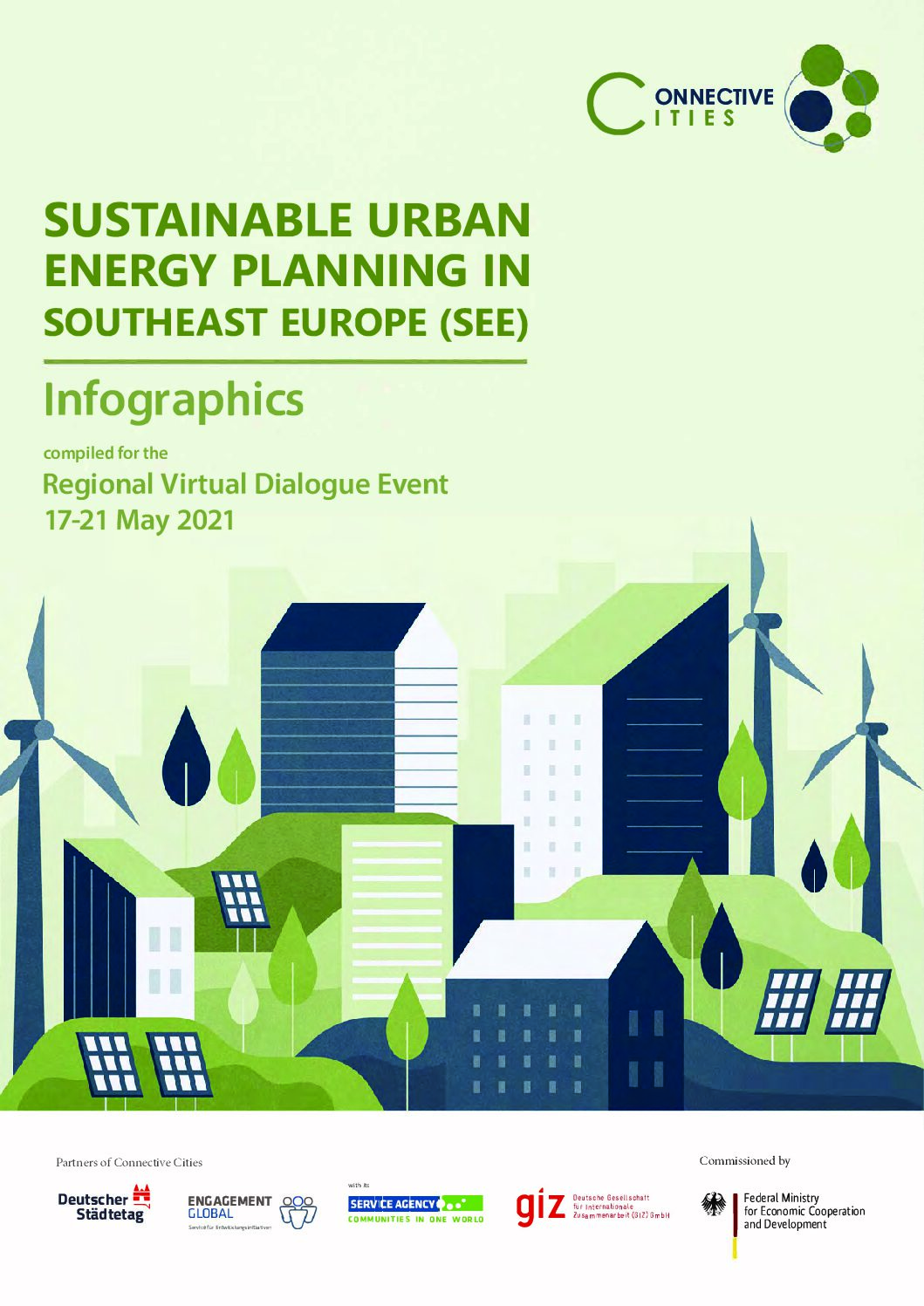
Sustainable urban energy planning in Southeast Europe – Infographics

These infographics illustrate the current context and importance of sustainable energy in SEE:

  • Final Energy Consumption rates of Southeast Europe (SEE) Region
  • Greenhouse gas emission rates in Southeast Europe (SEE) Region
  • Signatories of Covenant of mayors from Southeast Europe (SEE) Region
  • General Challenges of SEE Region in Energy Efficiency and Renewable Energy

The Case for a Green and Just Recovery

To provide decision-makers with more information on how stimulus packages may affect cities, this report compares how urban greenhouse gas emissions, health and jobs could fare under a green and just recovery compared to a return to a pre-COVID business-as-usual scenario, or a scenario where the world opts to spend stimulus funding on a high-carbon recovery.

The research finds that:

  • Stimulus funding that supports a green and just recovery offers a means to keep global heating below 1.5°C, and could reduce air pollution by as much as 29% between 2020-2030 compared to a return to business-as-usual. In contrast, investing an equivalent amount of stimulus funding in a high-carbon recovery would undoubtedly accelerate global heating.
  • Across the nearly 100 cities in the C40 network and their supply chains, a green and just recovery could also create over 50 million good, sustainable jobs by 2025 – over a third more than would be created by investing equivalent funds into a high-carbon recovery.

This research also shows that the timing of a green and just recovery matters, and presents a clear case for early investment. Modelling of the impacts of an ‘accelerated green recovery’ where faster capital investment enables accelerated climate action over the next five years, compared to a ’slow green recovery’ where action happens at a slower pace over 15 years, shows that:

  • An ‘accelerated green recovery’ could lead to half the per capita greenhouse gas emissions of a ‘slow green recovery‘ by 2030, meaning that an ‚accelerated green recovery‘ provides C40 cities with a greater chance of meeting their climate commitments and limiting global heating to 1.5°C.
  • An ‘accelerated green recovery’ could avert almost twice as many premature deaths (1.8 times as many) due to air pollution between 2020 and 2030, compared to a ’slow green recovery‘.
  • Capital investments that are made early on under an ‘accelerated green recovery’ could create over 80 million good, sustainable jobs by 2023, across the nearly 100 cities in the C40 network and their supply chains – more than double a ‘slow green recovery’. At a time of mass unemployment and economic hardship in many parts of the world, generating jobs now will benefit millions of families.

Sustainable urban energy planning in Southeast Europe (SEE)

The energy sector influences the vibrancy and sustainability of the entire economy – from job creation to resource efficiency and the environment. Significant shifts in the sector can have a strong ripple effect throughout the economy. Making the energy supply more cost-effective, reliable, secure, and environmentally sustainable thus contributes to the long-term resilience of economic development.

This concept paper describes the current context and importance of sustainable energy in SEE; current trends and scenarios in SEE; how SDG 7 and 13 as well as the Paris agreement affects the energy response in SEE; critical challenges for SEE to be energy responsive; some key steps needed for the future in SEE; energy financing – a key strategy for going forward; and finally the agenda for action for the dialogue event: sustainable urban energy planning in SEE.

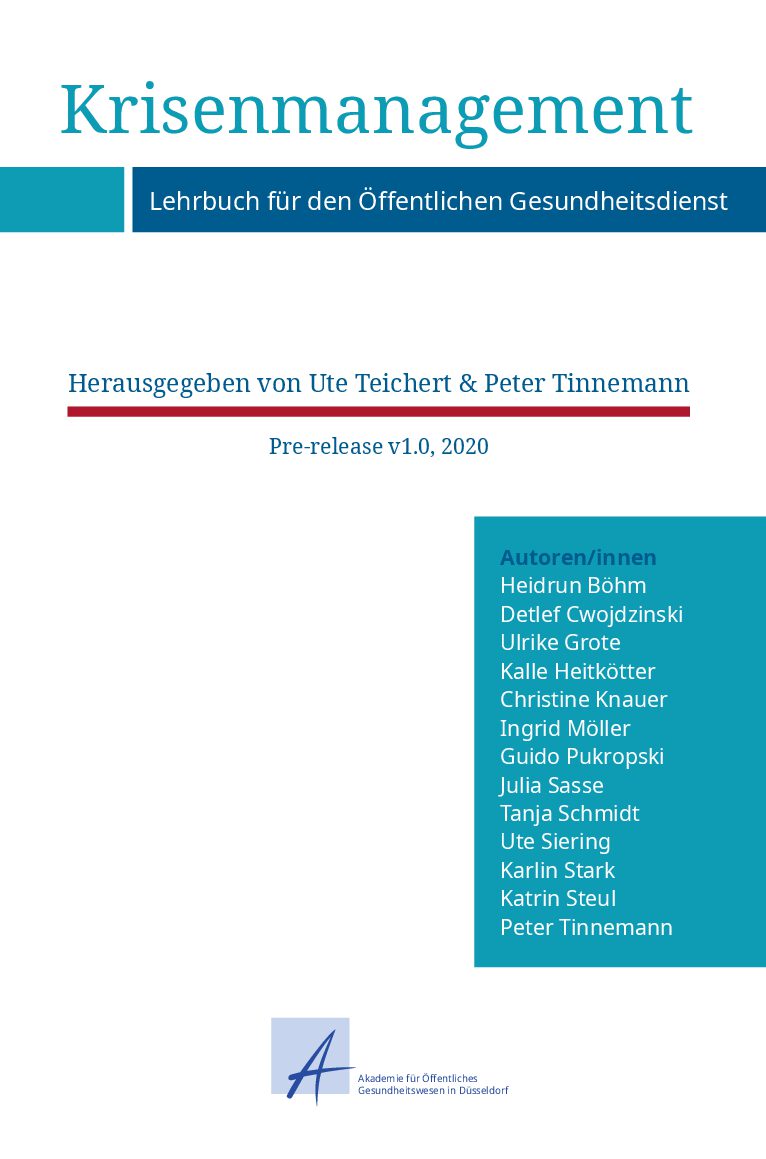
Krisenmanagement

Instrumente des Krisenmanagements helfen Mitarbeiterinnen und Mitarbeitern im ÖGD, die Arbeitsfähigkeit der Behörden in infektiologischen Gefahrenlagen sicherzustellen. Übliche Verwaltungsstrukturen werden den Anforderungen in einer Krise in der Regel nicht gerecht. So muss beispielsweise das Informations- und Kommunikationsmanagement an den gesteigerten Aufwand angepasst werden. Bei begrenztem Fachpersonal müssen Kompetenzen deshalb zentral gebündelt und bereitgestellt werden. Das Lehrbuch soll Mitarbeitern/innen in Gesundheitsämtern, aber auch aus anderen Einrichtungen des ÖGD, praktische Hinweise geben, wie sie sich zielgerecht auf die Gefahrenabwehr in Krisensituationen vorbereiten können, und Grundlagen des Krisenmanagements vermitteln. Neben fachlichen Gesichtspunkten werden insbesondere Handlungsempfehlungen für die Einsatzplanung und Stabsarbeit gegeben. Checklisten ergänzen das Lehrbuch als praktische Hilfsmittel.

Local Economic Development (LED) and Job Creation in Middle East and North Africa

Six municipalities from the MENA region have participated in the Local Projects Workshop, which was a 2-days virtual workshop held on the 19th-20th January 2021. The workshop consisted of a series of virtual discussions among the participating municipal representatives and technical and financial experts. The workshop was followed by two virtual sessions on proposal writing for funding and financing of municipal projects held on the 21st and 25th of January 2021 respectively.

The Local Projects Workshop was designed such that the activities are following a normal growth curve of what has been established during the LED Virtual Dialogue event that took place in 2020. The harmony established among participants and the understanding of the rationale of the Connective Cities methodology was expanded on to foster peer-to-peer learning with more attention given this time to individual municipalities needs and visions. The Local Projects Workshop approach leveraged the progress made to date by the 6 participating municipalities while addressing further actions including:

  • The interlinkages between LED projects and other areas like education, health, gender, environment, etc.
  • Adapting the LED projects to national and global objectives and priorities
  • Adapting the LED projects to available resources and existing expertise
  • Establishing Strategic and impactful partnerships for the projects
  • Risk forecasting and mitigation measures planning
  • Best approaches to fund projects with different financing mechanisms and tools.
     

COVID-19 implications in the Mediterranean

The brief cites regional examples from the South Mediterranean, sub-Saharan Africa and Germany on how governments and municipalities developed data dashboards and platforms and employed them in the pandemic response.

The policy brief concludes with an elaborate discussion on the implications and recommendations on how the current crisis can be turned into an opportunity for regional collaboration and promoting data-driven processes in the recovery from the pandemic.

Recommended policy actions include mapping the population that is in urgent need for vaccination, strengthening public health preparedness through bilateral and multilateral cooperation and creating Communities of Practice that contribute to promoting health equity.

Recommendations to promote data sets and data analytics in municipalities are also proposed, including the suggestion to integrate User-Friendly GIS software that is customized specifically for municipal use and written in the country’s native language, which could allow unlocking the geospatial system’s full potential.